Engineering rapid home tests for lupus diagnosis
Lead: Shuvethapriya Sampathkumar
Team Members: UG student interns
Collaborators: Ramesh Saxena, Michelle Petri, Ioannis Parodis
Project Summary:
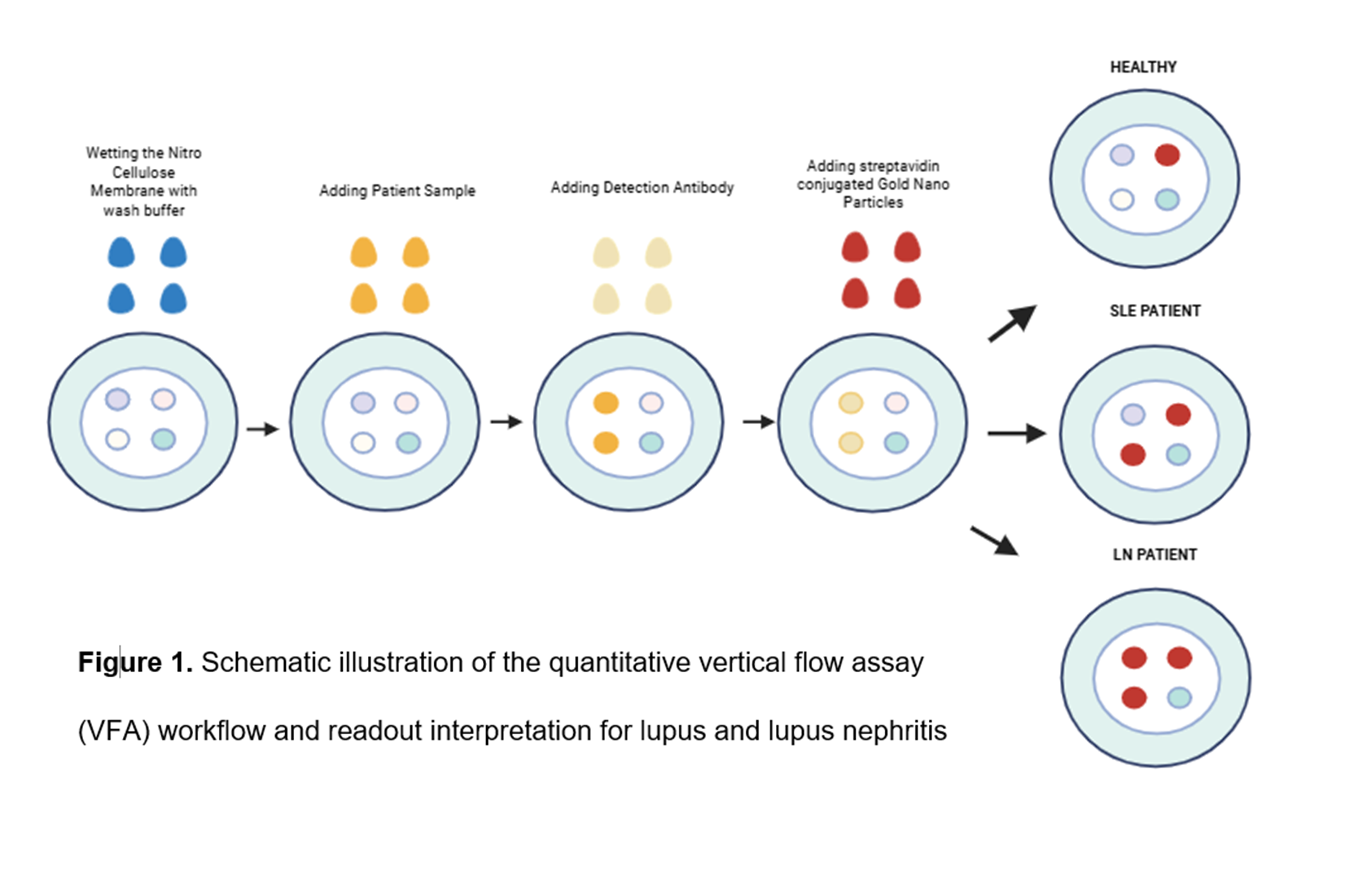
Systemic Lupus Erythematosus (SLE) is a chronic autoimmune disorder characterized by the production of autoantibodies that damage multiple organ systems, with lupus nephritis (LN) being one of its most severe and life-threatening complications. Early diagnosis and continuous monitoring are critical for preventing irreversible kidney damage. However, current diagnostic methods rely heavily on centralized laboratory testing that limits accessibility and delays clinical intervention. This research focuses on engineering a rapid, affordable, and user-friendly home diagnostic platform using a quantitative vertical flow assay (VFA) for the detection of key lupus biomarkers, along with integrated positive and negative control zones to ensure assay reliability and semi-quantitation, using small volumes of urine (or saliva) samples.
What is already known in the field?
- Rapid lateral flow and vertical flow assays offer low-cost and portable diagnostic solutions.
- Early detection significantly improves renal outcomes and reduces long-term morbidity in patients with lupus.
What is new?
- Development of multiplexed home-use vertical flow assays capable of detecting lupus-specific biomarkers and renal injury biomarkers simultaneously.
- Design of controlled flow architectures that improve reagent distribution and reduce assay time.
Why is this important?
- Enables early diagnosis and continuous disease monitoring without dependence on centralized laboratories.
- Reduces the need for invasive procedures.
- Improves accessibility of lupus care in underserved and remote populations.
Ongoing/future steps:
- Expanding biomarker panels.
- Conducting longitudinal validation studies with patient samples.
- Developing smartphone-integrated readout systems for digital result interpretation.